Thursday, August 13, 2015

Spilt Milk

The Milkman Murders
Writer: Joe Casey
Artist/Colourist: Steve Parkhouse
July-October 2004 (Hardcover edition August 2012)
Image Comics


"We need all sorts of horror stories just to understand our own lives." Editor Scott Allie, in his introduction to the original collected edition of The Milkman Murders from 2004 (then published by Darkhorse Comics), discusses his fascination with the horror genre. Rather, he describes horror not as a genre, but an emotion. Allie professes his love for various horror staples, be it vampire stories, Stephen King's Salem's Lot, or the classic Creature of Mary Shelley's creation. The horror that he wanted to bring to the table as an editor most of all however was a relatable kind. He refers to this as moral horror; horror that goes a step further than involving the anticipated genre tropes and monsters we see in so much horror media. Allie was interested in horror that has something to say, something to critique about society and humanity. These last few sentences are my words, but I think I translate his message accurately.

Original cover of issue #3
The Milkman Murders centres around the dysfunctional, white, middle-class Vale family that resides in the suburbs of America, filled with many identical houses and no shortage of concrete and asphalt, as many of us are familiar with. This story is somewhat anachronistic, as there are many 1950's post-WWII vibes and callbacks, both thematically as well as literally, yet it seems to take place in a more contemporary setting (as noted by the automobiles and the daughter's wardrobe). The initial and most blatant anachronism is the television show called "Leave it to Mother." Writer Joe Casey is clearly referencing the 50's show Leave it to Beaver, which also happens to showcase a white, middle-class family, although they are much more functional and seemingly relatable compared to the Vales. The two families juxtaposed against one another strengthens the dysfunction Casey is trying to get across with the Vale family, as well as satirizes both good ol' American values and just how plastic they are, as well as the increasing deterioration that occurs when a family remains disconnected from one another.

The Vale family consists of the stereotypical nuclear family: bread-winning father Vincent Vale; stay-at-home, caretaker mother Barbara Vale; first-born daughter, high-schooler Ruthie, and the younger, angsty son Fletcher. Barbara is the protagonist of this story. She is the glue of the Vale family, as she tries at every possible moment to communicate with and connect all four members to form a cohesive whole. Much to her detriment, Barbara's attempts fail each and every time and only worsen her relationships with her family. Vincent is an aggressive, abusive husband who flares up with intense anger at the most minute instances. Ruthie prioritizes her not-so-secret affair with her Phys. Ed teacher and spends as little time at home as possible. Fletcher hunts stray animals in the 'burbs and brings them back to his parents' basement where he has his way with them. He has a lock on the basement door, which neither of his parents are bothered by... which is one of the many signs of parental negligence showcased in this story. A brutal, unforeseen circumstance rears its ugly head at the end of the first chapter, which sparks the much needed change in the Vale family, for better or for worse.

The opening page of Chapter One
Steve Parkhouse's artwork fits the tone of Casey's script magnificently. Parkhouse's character designs are repulsive and showcase a sense of insecurity hidden within each one of them. He mixes curves and scratchiness to form a style all his own. Parkhouse is talented at portraying intense emotion in his characters, especially in his eye work. At times the art looks messy and rushed, but that compliments the story rather than hindering it since the characters and the world they inhabit is so ugly and horrific. Parkhouse's minimal use of shading during the penciling and inking stages is interesting; he adds shadows and definition in the colouring stage moreso than most artists' work I've read. This is reminiscent of Larime Taylor's toning work on A Voice in the Dark (or rather, the other way around).

It's interesting to note that the ugliness that exists within the characters' personalities translates well to their physical appearances. Vincent and Barbara in particular aren't a very attractive looking couple. It's clear through their actions that they don't take good care of their bodies, but Parkhouse takes this further in his depictions of them (they're overweight, disheveled, wrinkled, tired, and insecure looking folk). Parkhouse's backgrounds typically tend to be occupied by a singular colour, with little detail or noise occuring in the background. There are a good portion of scenes however that contain active backgrounds, mostly those that occur either outside the immediate premises of the house or in places such as Mass Mart. The panels with blank backgrounds are more often than not from scenes taken within the house, so there is a logic to their simpleness.

Just your average family meal... Part One
The Milkman Murders is a very dark tale that readers will either love or hate. I'd almost suggest putting a trigger warning on the cover as it is likely to stir up nasty emotions for some readers, however that would ruin the book's impact and change expectations, perceptions, enjoyment, and perhaps other aspects I'm failing to think of. It's full of obscene material, which on the surface can seem excessive and shocking with not much substance. Upon a closer examination, it's clear what is going on between the cracks: Casey and Parkhouse are reflecting our lives (North Americaners to be exact) onto the page and back at us. They are drawing from the more negative examples of Western culture, but that doesn't make them any less relevant than the idealized ones.

The characters and events are obviously extreme caricatures and exaggerations, but they have an element of truth to them that most readers can relate with to some degree. Domestic violence, profanity, television, advertising, disrespect (primarily towards one's parents), sex with a minor, the potential pre-stages of a serial killer - all of these things are on display in The Milkman Murders. Casey and Parkhouse provide no clear answers with this story, but rather raise questions through the narrative as to how this dysfunction manifests itself. Is it through parental neglect? Our 9-5 day job lifestyle/capitalist economy? The lack of positive role models in the children's lives? Traditional social norms? Television? Mass Mart (the fictionalized version of Wal-Mart)? Or, perhaps the most pertinent question raised: is it the suburbs themselves causing the decay of humanity? As Allie says in the closing remarks of his introduction, "Horror -- the emotion of horror -- thrives on mystery, and that kind of mystery provides no easy answers. Neither does this book."

Just your average family meal... Part Two

If you are a fan of comics taking a more high-art approach, then this is the comic for you. While The Milkman Murders exposes the problems and horrors of suburbia, the specific instances that occur in the Vale family's lives shouldn't be taken at face value, but rather as a critique of the bigger picture. It's hard to empathize with these characters, but damn is this a horrific and engaging satire. Buy a copy for your mom, if she's into this sort of thing.

Tuesday, August 11, 2015

A Voice in the Dark #1

A Voice in the Dark #1
Writer/Artist/Letterer/Super-Human: Larime Taylor
November 2013
Image Comics/Top Cow/Minotaur Press


A Voice in the Dark #1 is many things, but the most pertinent feature about it to me is its allegorical nature. The book is symbolic of the acceptance of difference, as well as acts as a comment towards the lack-of it in the contemporary West (I'm specifically pointing the finger at Republican/Conservative values). While it's a cliche to say that difference and diversity still aren't accepted and rejoiced here in North America, despite the increasing amount of various social media groups and political movements aimed at strengthening diversity and increasing empathy with and towards others, it still has an element of truth to it.

We see diversity in Larime Taylor's Image Comics debut A Voice in the Dark #1 in abundance, but primarily through protagonist Zoey Aarons. She is the embodiment of diversity and difference: she's mixed-race, female, lower-middle class, and a young, slightly insecure college freshman. To top it off, she's recently become part of another "outsider" demographic: she's a killer.

This is the main hook of the book. There are certainly other intriguing elements to this narrative, but Zoey's persona as a freshly established killer is the dominant focus here. Taylor wastes no time with set-up or beating around the bush. He throws the reader right into the story, beginning with Zoey's first homicidal act. Through first-person narration (Zoey's diary entries) the reader gets an insider's point of view into the life of a newborn murderer.

Besides being about a fledgling college-freshman-moonlighting-as-a-serial-killer, A Voice in the Dark #1 is about the transition into adulthood. It's also about the importance of family and connecting with friends. The book is inclusive of both non-white characters as well as queer folk, without ever being awkward about it. A good portion of the cast are female, which is also refreshing. There's also a little bit of detective work showcased here, as well as the beginnings of Zoey's radio show. So much happens in this first issue (it is 36 pages long after all), yet it all works without feeling bloated. The pacing is top notch. Taylor has an excellent sense of when to cut one scene and begin another, seemlessly transitioning one scenario to the next.


Opening page
Following the opening scene depicting Zoey's first kill, A Voice in the Dark #1 cuts to Zoey and her family arriving at her new destination: college. We learn here that her father is black and her mother is white, and her best friend and now sister, the recently adopted Seven, is of Asian descent. Seven joins Zoey for her interview with the campus radio programmer named Jill. It is here, and during many other scenes, where Zoey has one of her first day dreams about killing. With these visions Taylor adds a touch of dark humour to the book, especially later on during class as well as when Zoey meets her roommates.

Zoey doesn't discriminate when it comes to killing, at least insofar as her visions go, although it seems that her motives when killing outside of her imagination are premeditated. It's tough to pinpoint her killing style just yet, but from the one instance so far, it was not an impulse kill. This killing business occupies an awful lot of space in her mind, so much so that Zoey begins talking to herself in the washroom. Zoey's guilt causes her to experience a moral dilemma about her first kill (as I'm sure most of us would), and she tries to understand why she did it by talking to herself in the mirror (which, as it's made clear, her reflection is the darkness she feels inside of her that made her kill).


The first mirror scene


Zoey's darkness tells her that she was "born wrong," which I find fascinating in terms of thinking about A Voice in the Dark as an allegorical narrative. It springs to mind all the hate, bullying, suffering, and insensitivity that exists in our society, which tends to occur when "normal" people don't understand someone who is different from them in terms of sexuality, race, religion, (dis)ability, politics and a plethora of other aspects. It exposes the fear those type of people have, which is exactly what Zoey is going through mentally and emotionally as she processes her actions. It's this fear that she is trying to overcome, so in a way, Zoey is struggling to overcome her insecurity and reluctance to accept her nature as a killer. This isn't to say that in order for Western society to become more diverse, we need to accept and tolerate killers, but rather it's an interesting way for Zoey to come to terms with her idea of self.

This type of killer narrative has been done numerous times now across various media, with the most notable examples being the Showtime TV series Dexter (2006) and Mary Harron's film American Psycho (2000). While Patrick Bateman in American Psycho is hardly a character viewer's can empathize with, Dexter Morgan on the other hand has codes and principles he lives by so as to justify his murderous tendencies, and has a suave and enticing charm that helps reel viewers in. Zoey Aarons however is relatable in almost every way aside from her new found pastime. She embodies both the strength to continue moving forward even when we've made a choice we are seriously unsure about, as well as the uncertainty and contemplation we experience as we grow up. Zoey's a very well-rounded character and it shows as the issue goes on. Like Dexter Morgan before her, Zoey is a very likeable killer. She's shy and introverted, but having her diary entries present helps the reader to better understand her motivations both in regards to her killing and the life she is building outside of it.

Zoey's first daydream
Besides writing the book, Larime Taylor also handles illustrating, toning, and lettering it. His black and white artwork is a breath of fresh air compared to the harsh linework and scratchiness that has become the norm in many superhero comics. Taylor utilizes curves in his figures and doesn't typically use line shading as is the norm at DC Comics (Jim Lee immediately comes to mind). The shading here is created after the penciling/inking process, as Taylor tones the book (adding grey tones to ascribe definition; a process similar to colouring) which gives it a more naturalistic look than the excessive lines we see so often.

As I mentioned in the opening, my favourite aspect of this book is the way in which it is allegorical of the acceptance of difference. Zoey struggles to accept herself because of her secret, however she is a mature and proactive individual, especially for her age, as she seeks to discover solace and a way to help others who feel outcasted as she does through her talk show.

Rather than being a killer narrative focused on sensationalist features such as violence and bloodshed, A Voice in the Dark #1 is above that. Taylor seeks to share with his readers that being different is okay. I wouldn't say he is pro-serial killers outside of fiction, but he certainly suggests that no matter how different we are from others, there are ways of making the best of situations. Having said that, there is still murder present in this book, it's just not all that A Voice in the Dark relies on to shape its story. I will touch on plot and characters more in my post about issue #2. I must say though, the ending is quite climactic and hair-raising. Taylor does not disappoint!

Monday, August 10, 2015

Attica! Attica!

The Auteur #2
Writer: Rick Spears
Artist: James Callahan
Colours: Luigi Anderson
Letters: Sick Rears
April 2014
Oni Press


Despite having read this series when it was originally released, I've been having a blast rereading it, especially the bits that my brain forgot to absorb. The Auteur is very likely the most fun I've had reading ongoing comics. Robinson and Hinkle's Airboy is a close second (review of that coming next week!). As the first issue did, The Auteur #2 continues to parody and mock genre tropes, particularly horror ones this time around. There are also jabs at courtroom dramas and the legal system. Although I haven't seen it, the film A Few Good Men springs to mind when reading these scenes.

While I think The Auteur #1 was wonderfully balanced in terms of plot, character, and story development, especially for a first issue, The Auteur #2 takes it a step further and tightens its focus. While the first issue set the stage for the series, issue #2 tells a smaller story about how Nathan T. Rex managed to have the savage serial killer Darwin released from prison to be the murder consultant on his new film project, President's Day. (Imagine if something like this happened for the TV show Dexter... geezus.) Without spoiling details, as I'm sure you can imagine, T. Rex goes to some pretty great lengths to have Darwin released from incarceration. It's bizarrely satisfying to listen to his claims for the release of Darwin; it reminds me of some bat-shit wacko ideas that some right-wingers have. Just like everything else in the book, those are obviously just as exaggerated as everything else (but are they really though?).


Opening page
There are mild references to films such as Rosemary's Baby, The House of the Devil, Psycho, Friday the 13th, and perhaps others that I may have missed. There is a notable reference to Dog Day Afternoon that made me both chuckle and feel giddy since it worked so well in the story. All in all, this issue is loads of fun for fans of horror cinema, although I would say that the story doesn't really have anything to do with making films per se. It's moreso about the various processes that can occur during the pre-production stage of filmmaking, albeit an exaggerated one at that.

What impresses me so much about this series on the surface is the zaniness and unpredictability within its premise. The creative team is always finding ways to take the parody of mainstream Hollywood cinema further and make a mockery of it. It's so silly and ludicrous yet it never disappoints - the laughs are always there and the writing is top notch. The art is gorgeously rendered for such disgusting ideas and is consistent between panels of action and those of moments leading up to said action. Besides the obvious aspects, I appreciate how tightly knit the book is. Everything from pacing to panel layouts, and dialogue to character designs - you can tell the creators put their best efforts forth crafting this comic. The Auteur is not for everybody, but I'll be damned if someone told me it wasn't a well made comic.

Another ad featured in Oni Press publications

Sunday, August 9, 2015

Steve Snow - Prime Minister 2015

Now that I'm blogging again, it might be a good idea (probably isn't) to give you an idea as to what specific comics series I will be reviewing on a regular basis, as well as the overall goals I have with this blog (Goals? Who has goals anymore?).

As a slowly maturing human being, I've noticed that my tastes in comics have also been slowly maturing, although perhaps my sense of humour, while simultaneously irreverent and critical in a (sometimes) sneaky, trollish fashion, still remains the same (for better or for worse). What I mean by maturing is that I'm more interested in reflexive and critical comics fare, which primarily includes independent and alternative works rather than commercial ones. I'm not quite sure where Image Comics falls under that category, but I consider them to be moreso independent despite their recent fame and increased presence in the media. This isn't to say that I dishone or disprove of commercial comics (by that I am referring to DC Comics and Marvel, aka "The Big Two" publishers), but in the world we live in - one in which we have limited time and money (and resources) - one cannot simply read or buy everything. Might I add that I am still of reader of both DC and Marvel, albeit a limited one, but I am not advocating that people who enjoy them stop reading them. I insist the opposite: keep reading the series you enjoy. Keep supporting the books and creators you love. Ensure that what you are buying you are genuinely interested in, and that you haven't fallen into the routine of supporting a series simply because it's something you've become accustomed to (you don't actually need to own every single issue of Detective Comics, especially if you haven't been enjoying reading it for quite some time).


If I don't support my favourite independent creators,
they will die!
It's also important for me to use my purchases as a communicator of my politics and what I'm interested in reading, as that is the major way to personally impact the market and have a say in what kind of material is produced. It's a relatively small statement of course, but you do what you can. By this I mean, if everyone continues to buy and support a series, said series will flourish and be published so long as the demand is there and profit can be made. Your purchase of said series demonstrates to the publisher that you want them to keep putting that series out each month (even if you thought the issue was mediocre or forgettable). Some of the creators I'm interested in these days (I'll name them soon, I swear) aren't exactly as in demand as those creating the big name superhero comics, so they could really use my support (and yours also!) to ensure that they stay employed, as well as continue creating new material. The other way one can begin to affect the market is to start creating their own comics. (Ahem. I'm working on that one. I've discovered that it takes a bit more time creating them than it does reading them...)

Having mildly forced my views upon you, oh gracious reader, I present to you a rough list of the comics I will continue (and begin in most cases) to read, rant, and rave about:

Image Comics:

- Bitch Planet
- Descender
- God Hates Astronauts
- Kaptara

- Minimum Wage
- Saga
(trade collections only!)
- Sex Criminals
- Southern Bastards
- A Voice in the Dark
- We Stand on Guard


Oni Press:

The Auteur

Besides the limited number of ongoing series' I plan on discussing on a regular basis, I will also regularly review some graphic novels and miscellaneous work from some of my favourite creators, including but not limited to: Ted McKeever, Jeff Lemire, Chester Brown, Junji Ito, Jason, and Robert Crumb. Specific books that I'm itching (I'm quite literally scratching my arm as I type this) to share my thoughts on include The Milkman Murders (Joe Casey & Steve Parkhouse), Strong Female Protagonist (Brendan Lee Mulligan and Molly Ostertag), Fun Home (Alison Bechdel), and Stray Bullets (David Lapham).

There are a plethora of other creators and books I will take a gander at, as I plan on covering a lot of ground over the next few years. Until next time...

Stay Tuned!

Saturday, August 8, 2015

The Same Photo of Jim Carrey Every Day


Bitchin'

Bitch Planet #2
Writer: Kelly Sue DeConnick
Art/Covers: Valentine de Landro
Colour: Cris Peter
Letters: Clayton Cowles
January 2015
Image Comics

I completely forgot to bring attention to the tagline of Bitch Planet in my last post. This brings to mind the Always commercial #LikeAGirl I saw months ago about how toxic and sexist language can be when used certain ways (https://www.youtube.com/watch?v=XjJQBjWYDTs).

It may seem simple and insignificant, perhaps even amusing to see the cliched "Are you man enough to blah blah blah?" take a different spin, but it's actually calling into question what we tend to take for granted and naively assume: that the pinnacle of power and what we should all strive to be is a man (a powerful and dominating man at that). To say that someone throws like a girl is insulting not because the insulter is mocking the insultee for her/his/their throwing ability, but because that kind of insult implies that being a girl is a bad thing. This stereotype can be seen in the first round of questioning in the Always video. (To what extent the commercial is staged and scripted, we'll never know, but it's message is still pertinent regardless of whether or not the "actors'" responses are genuine testimonials). The seemingly innocent responses from the actors is at first amusing, as orchestrated by the actors expressions as well as the editing. The commercial takes a turn for the sappy and makes its moral message very clear (ugggghh, the music).

Despite tackling this issue in a commercial for a corporation that creates tons of waste every year (check out the less wasteful form of feminine hygiene: http://divacup.com/) - well wait, a fucking company is trying a sympathy tactic to get consumers to buy their product because they're progressive... that's not creepy at all... - at least it provided a forum for which to discuss this issue. So kudos to Always for that (still a creepy, capitalist way of doing things).


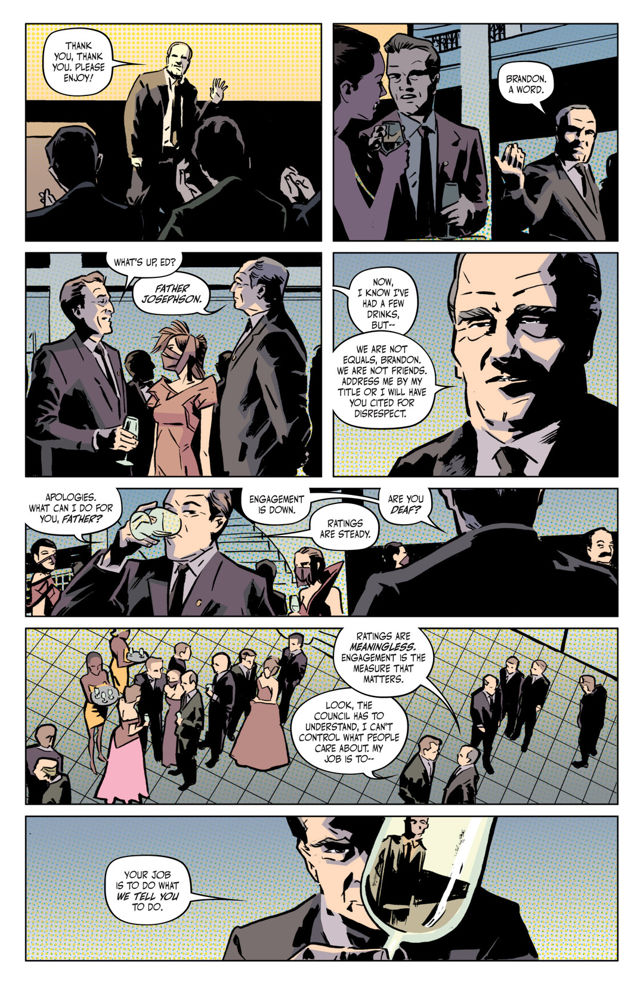
Ahem. So Bitch Planet #2. I hereby declare that I won't be so harsh and negative this time around. I am still not a fan of Valentine de Landro's art, but my complaining and bickering won't do anything to improve it so I'll instead focus on the positives of this issue. The story moves forward and presents a clear plot that we can look forward to seeing develop. We are introduced to a new key player who goes by the name Father Josephson (Jesus allusion?). Whether he is a priest has yet to be seen, but I'd like to wager a guess and say that "Father" is a term that is used in Bitch Planet to designate status for respected and powerful men.

Father Josephson embodies the characteristics of a self-serving, ego-driven leader who spouts jargon about being united as a race despite being divided by blood and geography - in other words, we're divided into the privileged and the unprivileged. "The us... and the them" as Josephson puts it. He also portrays Republican and Conservative attitudes, through his obvious privilege, in his desire to uphold his authority in the presence of employees, and his vehement concern with imposing his beliefs upon others in vulnerable positions (namely the prisoners of Bitch Planet).

Presumably the series' protagonist, Kamau Kogo is given the most panel time out of any of the prisoners this issue. In a conversation with guard Miss Whitney, Kamau is given an ultimatum: form a Megaton team (a mysterious sport that was the main topic of Father Josephson's speech in the opening scene) consisting of other inmates, or decline to do so and face an extended sentence for "killing" inmate Marian Collins (see last issue). Miss Whitney gives an impressive speech about sports culture and building character the ol' patriarchal way. Kamau's situation can be read as a metaphor for how women don't have any choice but to exist in a patriarchal world, suffer the indecencies that exist within it, and play by those rules to succeed in society (which is obviously what team Bitch Planet is critiquing).

During Kamau's recruitment efforts, we're introduced to yet another character who will likely be a main player. Meiko's her name, and despite Kamau's stubbornness and reluctance to agree to Miss Whitney's demands, Meiko convinces Kamau with an enticing offer that immediately convinces her to assemble the team.

In the final scene, Father Josephson's corrupt nature is further confirmed when business and economic interests supersede empathy and understanding. There is a budding partnership forming between Father Josephson and Roberto Solanza (overseer of the A.C.O.; introduced in the first issue) which poses to be dangerous for the inmates of Bitch Planet.

Bitch Planet is turning out to be better than I initially thought, at least story-wise. Now that some direction has been established and stakes raised, Bitch Planet is a series I feel vested in reading. Aside from failing to mention the comic's slogan, I also forgot to bring up how awesome the backmatter is after the story. Each issue features a feminist essay by professional feminists (well educated feminist writers who I imagine majored in Gender/Womens Studies) and further creates dialogue about issues both raised within the story as well as outside of it. I'm not sure whether these feminist essays will be included in the collected editions, so best to snag single issues to read them!


Friday, August 7, 2015

The Auteur #1

The Auteur #1
Writer: Rick Spears
Artist: James Callahan
Colours: Luigi Anderson
Letters: Sick Rears
March 2014
Oni Press


Quite the antithesis to what Bitch Planet is doing, The Auteur is a series that is hellbent on being as politically incorrect and unethical as possible. But that's the point. In a world over-saturated with superhero comics, many of which feature offensive material ranging from mild racism to blatant sexism, as well as recycled narrative tropes and an endless onslaught of genre conventions, comes The Auteur. Editor Charlie Chu describes the comic in his afterward as "...hysterical, profane, and more than likely to get us all in trouble for publishing it."

Just look at the cover. The blood for one thing hints at the level of gore you'll find inside the book. And the bulging eyeball from protagonist's (if that's even a viable label for the main character...) head. Not to mention the eyeball-mouth replicating his smile, along with a tiny mustache to match. The cover is a clear indicator of the irreverent style and direction The Auteur is headed in and it definitely isn't for everyone.

This book is loud. Obnoxious. Offensive. It's so over the top and ridiculous that it seems strange that anyone could think it was being serious.

Interior page

The titular Auteur is Nathan T. Rex: multi-millionaire producer of such fare as Death Fist, The Ten Commandments 2, and Zombie High. Rex is a rising star in Hollywood and usually makes studios big bucks. But his latest feature Cosmos, the first in a simultaneously shot space-opera trilogy (the second titled Revenge of the Oppressor and the third The Space Blade Rallys... I'll let you figure out the reference), has flopped at the box office and both the media and studio executives are worried about Rex's future in filmmaking. 

The story begins with Rex falling into a hallucinatory pool which he refers to as "Idea space." Rex sifts through a plethora of generic ideas and character archetypes in the shallow waters of his mind, but quickly descends further into the depths of his unconscious. Besides being an amusing jab at the commodity of ideas present within much of mainstream media, this opening sequence is a fun and self-reflexive venture that sets the tone for the series quickly and accurately. Nathan T. Rex is on adventure in bad taste to find the redeeming idea for his next project. Spoiler alert: he finds it on the second page.

Determined to create his magnum opus, Nathan T. Rex takes a well known historical figure and puts an absurd spin on him. Sort of anyway. Currently working as the producer of the horror-thriller President's Day, T. Rex assumes the director's chair, shunning the actual director, and insists that the crew deviate from the generic script and instead go in an equally generic new direction. T. Rex is certain that his revisions will garner him the artistic credibility he feels he deserves, as well as make the studio millions of revenue. A win-win, right? All while exploiting exploitation horror cinema in the process.

Nathan T. Rex plummeting further into the cesspool of his imagination.

James Callahan's art is impeccable. It compliments writer Rick Spears' zany and vile script nicely, bringing a crisp and high-definition quality to every panel. Callahan's precise pencils showcase the mundane to the grotesque: from brains-splattering beyond the reaches of the page to mere conversations between T. Rex and his boss, every shot looks deliberately rendered and carefully crafted.

Luigi Anderson's colours can't go without mentioning. The Auteur is vibrant and luscious, often evoking some of the radical colouring of both 1980s cinema and comics. Unlike some comics which focus on using a limited colour palette, Anderson uses virtually every colour in the spectrum. Each scene is lit in its own distinct way which seamlessly transitions from one to the next. In some cases the colour is indicative of what kind of emotion or general feeling the scene evokes (red during a strip club visit, darker neutral tones during nighttime, and a scattershot amalgamation of colours during Rex's concluding epiphany).

And Sick Rears' lettering... Oooooh, I see what you did there.

An advertisement for the first issue that appeared in Oni Press publications.

Filled with excessive violence, misogyny, rich Hollywood assholes, a shaman named Dr. Love, and numerous film references, The Auteur is a knockout first issue that proves original ideas still exist in the comics industry and that we shouldn't lose hope just yet.